
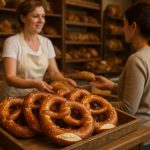

Hallo und herzlich willkommen bei Blazing Deutsch! Ich bin Lukas, euer Gastgeber für diesen täglichen Podcast. Hier lernt ihr Deutsch ganz entspannt, indem wir über die deutsche Kultur, das alltägliche Leben und natürlich über leckeres Essen sprechen. Diese Woche dreht sich bei uns alles um das Thema „Deutsche Küche“. Heute schauen wir uns ein echtes Symbol der deutschen Backkunst an: die Brezel. Bestimmt habt ihr sie schon einmal gesehen oder sogar probiert. Aber wisst ihr auch, woher sie kommt und warum sie so unglaublich beliebt ist? Genau darum geht es in der heutigen Folge.
Bevor wir in die Geschichte eintauchen, möchte ich euch fünf wichtige Wörter vorstellen, die ihr heute in der Folge hören werdet. Achtet mal darauf, wenn ich gleich über das Backen spreche. Die Wörter sind: die Lauge, der Teig, knusprig, salzig und das Wahrzeichen.
Wenn man an Deutschland denkt, hat man oft sofort das Bild einer Brezel im Kopf. Sie riecht einfach wunderbar, wenn sie frisch aus dem Ofen kommt. Aber was macht eine echte Brezel eigentlich so besonders? Es ist vor allem die Herstellung. Zuerst macht der Bäcker einen einfachen, festen Teig aus Mehl, Wasser, Hefe und etwas Salz. Dieser Teig wird dann in die typische Form gebracht, mit den gekreuzten Ärmchen in der Mitte. Und jetzt kommt das große Geheimnis: Vor dem Backen wird die Brezel kurz in eine spezielle Flüssigkeit getaucht. Diese Flüssigkeit nennen wir Lauge. Erst durch diese Lauge bekommt die Brezel beim Backen ihre typische, dunkelbraune Farbe und diesen ganz besonderen, kräftigen Geschmack. Wenn die Brezel dann fertig gebacken ist, ist sie außen wunderbar knusprig, aber innen noch ganz weich und fluffig. Meistens streut man auch noch grobes Salz auf die Oberfläche. Deshalb schmeckt sie auch so angenehm salzig. Die Brezel ist heute ein echtes Wahrzeichen für das deutsche Bäckerhandwerk. Man findet sie überall, besonders in Süddeutschland, wo sie zum Frühstück oder als Snack zwischendurch einfach dazugehört. Die Geschichte der Brezel ist übrigens sehr alt. Schon im Mittelalter haben Mönche dieses Gebäck gebacken, und die Form sollte wahrscheinlich betende Arme darstellen. Faszinierend, oder?
Das ist wirklich eine interessante Geschichte. Lasst uns jetzt noch einmal kurz auf die fünf Wörter schauen, die wir gerade gehört haben, damit ihr sie euch gut merken könnt.
Als Erstes hatten wir das Wort die Lauge. Das ist die spezielle Flüssigkeit, in die das Gebäck vor dem Backen getaucht wird. Ein Beispiel: Für eine echte Brezel braucht man unbedingt Lauge.
Das zweite Wort ist der Teig. Das ist die weiche Mischung aus Mehl und Wasser, die man knetet, bevor man sie backt. Zum Beispiel: Der Teig für das Brot muss eine Stunde lang ruhen.
Unser drittes Wort ist knusprig. Das beschreibt Essen, das beim Hineinbeißen ein lautes, trockenes Geräusch macht und fest ist. Ein Beispiel: Ich mag frische Brötchen am liebsten, wenn sie noch ganz knusprig sind.
Als Viertes haben wir das Wort salzig. Das bedeutet, dass etwas nach Salz schmeckt oder viel Salz enthält. Ein Beispiel: Die Suppe schmeckt mir heute ein bisschen zu salzig.
Und das fünfte Wort ist das Wahrzeichen. Das ist ein Symbol oder eine Sehenswürdigkeit, die ganz typisch für eine Stadt oder ein Land ist. Zum Beispiel: Das Brandenburger Tor ist ein bekanntes Wahrzeichen von Berlin.
So schnell vergeht die Zeit! Macht euch keine Sorgen, wenn ihr nicht jedes Wort sofort verstanden habt. Das Lernen einer Sprache braucht Zeit und passiert ganz von alleine, wenn man jeden Tag ein bisschen zuhört. Schön, dass ihr heute dabei wart! Morgen geht es in unserer Themenwoche „Deutsche Küche“ um einen weiteren absoluten Klassiker. Wir sprechen über die Bratwurst und ihre vielen regionalen Varianten in Deutschland. Das solltet ihr nicht verpassen! Bis morgen, euer Lukas. Tschüss!
English
Hello and a warm welcome to Blazing Deutsch! I am Lukas, your host for this daily podcast. Here you learn German in a very relaxed way by talking about German culture, daily life, and of course, delicious food. This week, everything revolves around the theme of “German Cuisine”. Today we are looking at a real symbol of German baking: the pretzel. You have probably already seen it or even tried it. But do you also know where it comes from and why it is so incredibly popular? That is exactly what today’s episode is about.
Before we dive into the history, I would like to introduce you to five important words that you will hear today in the episode. Watch out for them when I talk about baking in a moment. The words are: die Lauge (lye), der Teig (dough), knusprig (crispy), salzig (salty) and das Wahrzeichen (landmark).
When you think of Germany, you often immediately have the image of a pretzel in your head. It smells simply wonderful when it comes fresh out of the oven. But what actually makes a real pretzel so special? It is, above all, the preparation. First, the baker makes a simple, firm der Teig out of flour, water, yeast, and some salt. This der Teig is then shaped into the typical form, with the crossed little arms in the middle. And now comes the big secret: before baking, the pretzel is dipped briefly into a special liquid. We call this liquid die Lauge. Only because of this die Lauge does the pretzel get its typical, dark brown color and this very special, strong taste during baking. When the pretzel is finished baking, it is wonderfully knusprig on the outside, but still very soft and fluffy on the inside. Usually, coarse salt is also sprinkled on the surface. That is why it also tastes so pleasantly salzig. Today, the pretzel is a real das Wahrzeichen of the German baking craft. You can find them everywhere, especially in southern Germany, where they are simply part of breakfast or a snack in between. By the way, the history of the pretzel is very old. Already in the Middle Ages, monks baked this pastry, and the shape was probably meant to represent praying arms. Fascinating, right?
That is indeed an interesting story. Now let’s take another quick look at the five words we just heard so that you can remember them well.
First, we had the word die Lauge. That is the special liquid into which the pastry is dipped before baking. An example: Für eine echte Brezel braucht man unbedingt Lauge. (For a real pretzel, you absolutely need lye.)
The second word is der Teig. That is the soft mixture of flour and water that you knead before baking it. For example: Der Teig für das Brot muss eine Stunde lang ruhen. (The dough for the bread must rest for one hour.)
Our third word is knusprig. That describes food that makes a loud, dry sound and is firm when biting into it. An example: Ich mag frische Brötchen am liebsten, wenn sie noch ganz knusprig sind. (I like fresh bread rolls best when they are still very crispy.)
Fourth, we have the word salzig. That means that something tastes of salt or contains a lot of salt. An example: Die Suppe schmeckt mir heute ein bisschen zu salzig. (The soup tastes a bit too salty to me today.)
And the fifth word is das Wahrzeichen. That is a symbol or a landmark that is very typical of a city or a country. For example: Das Brandenburger Tor ist ein bekanntes Wahrzeichen von Berlin. (The Brandenburg Gate is a well-known landmark of Berlin.)
Time flies so fast! Do not worry if you did not understand every word right away. Learning a language takes time and happens all on its own if you listen a little bit every day. It is great that you were here today! Tomorrow in our theme week “German Cuisine”, we will talk about another absolute classic. We will talk about the bratwurst and its many regional varieties in Germany. You should not miss that! Until tomorrow, your Lukas. Bye!
Español
¡Hola y bienvenidos a Blazing Deutsch! Soy Lukas, su anfitrión de este podcast diario. Aquí aprenderán alemán de manera muy relajada, hablando sobre la cultura alemana, la vida cotidiana y, por supuesto, la deliciosa comida. Esta semana, todo gira en torno al tema de la “Cocina alemana”. Hoy analizaremos un verdadero símbolo del arte de la panadería alemana: el pretzel. Seguro que ya lo han visto o incluso probado. Pero ¿saben también de dónde viene y por qué es tan increíblemente popular? De eso se trata exactamente el episodio de hoy.
Antes de sumergirnos en la historia, me gustaría presentarles cinco palabras importantes que escucharán hoy en el episodio. Presten atención cuando hable de hornear en un momento. Las palabras son: die Lauge (solución alcalina), der Teig (masa), knusprig (crujiente), salzig (salado) y das Wahrzeichen (símbolo).
Cuando uno piensa en Alemania, a menudo tiene inmediatamente la imagen de un pretzel en la cabeza. Huele simplemente de maravilla cuando sale fresco del horno. Pero ¿qué hace que un verdadero pretzel sea realmente tan especial? Es, sobre todo, la preparación. Primero, el panadero hace una der Teig simple y firme de harina, agua, levadura y un poco de sal. Esta der Teig se lleva luego a su forma típica, con los bracitos cruzados en el centro. Y ahora viene el gran secreto: antes de hornear, el pretzel se sumerge brevemente en un líquido especial. A este líquido lo llamamos die Lauge. Solo gracias a esta die Lauge, el pretzel obtiene su color marrón oscuro típico y este sabor tan especial y fuerte al hornearse. Cuando el pretzel está terminado de hornear, queda maravillosamente knusprig por fuera, pero por dentro sigue siendo muy suave y esponjoso. Por lo general, también se espolvorea sal gruesa sobre la superficie. Por eso también sabe tan agradablemente salzig. Hoy en día, el pretzel es un verdadero das Wahrzeichen de la panadería alemana. Se encuentra en todas partes, especialmente en el sur de Alemania, donde simplemente forma parte del desayuno o como un bocadillo a cualquier hora. Por cierto, la historia del pretzel es muy antigua. Ya en la Edad Media, los monjes horneaban este pan, y la forma probablemente debía representar unos brazos rezando. Fascinante, ¿verdad?
Esta es realmente una historia interesante. Ahora miremos una vez más brevemente las cinco palabras que acabamos de escuchar, para que puedan recordarlas bien.
En primer lugar, teníamos la palabra die Lauge. Ese es el líquido especial en el que se sumerge el pan antes de hornearlo. Un ejemplo: Für eine echte Brezel braucht man unbedingt Lauge. (Para un verdadero pretzel, necesitas absolutamente solución alcalina.)
La segunda palabra es der Teig. Esa es la mezcla suave de harina y agua que se amasa antes de hornearla. Por ejemplo: Der Teig für das Brot muss eine Stunde lang ruhen. (La masa para el pan debe reposar durante una hora.)
Nuestra tercera palabra es knusprig. Eso describe la comida que hace un sonido fuerte y seco al morderla y que es firme. Un ejemplo: Ich mag frische Brötchen am liebsten, wenn sie noch ganz knusprig sind. (Me gustan más los panecillos frescos cuando aún están muy crujientes.)
En cuarto lugar, tenemos la palabra salzig. Eso significa que algo sabe a sal o contiene mucha sal. Un ejemplo: Die Suppe schmeckt mir heute ein bisschen zu salzig. (La sopa me sabe hoy un poco demasiado salada.)
Y la quinta palabra es das Wahrzeichen. Ese es un símbolo o un monumento característico que es muy típico de una ciudad o un país. Por ejemplo: Das Brandenburger Tor ist ein bekanntes Wahrzeichen von Berlin. (La Puerta de Brandeburgo es un símbolo conocido de Berlín.)
¡Qué rápido pasa el tiempo! No se preocupen si no entendieron cada palabra de inmediato. Aprender un idioma lleva tiempo y ocurre por sí solo cuando uno escucha un poco cada día. ¡Qué bueno que nos hayan acompañado hoy! Mañana, en nuestra semana temática “Cocina alemana”, hablaremos de otro clásico absoluto. Hablaremos de la bratwurst y sus muchas variantes regionales en Alemania. ¡No se lo deberían perder! Hasta mañana, su Lukas. ¡Adiós!
Français
Bonjour et bienvenue sur Blazing Deutsch ! Je suis Lukas, votre hôte pour ce podcast quotidien. Ici, vous apprenez l’allemand en toute détente, en parlant de la culture allemande, de la vie quotidienne et, bien sûr, de nourriture délicieuse. Cette semaine, tout tourne autour du thème de la « Cuisine allemande ». Aujourd’hui, nous nous intéressons à un véritable symbole de l’art de la boulangerie allemande : le bretzel. Vous l’avez certainement déjà vu ou même goûté. Mais savez-vous aussi d’où il vient et pourquoi il est si incroyablement populaire ? C’est exactement le sujet de l’épisode d’aujourd’hui.
Avant de plonger dans l’histoire, j’aimerais vous présenter cinq mots importants que vous entendrez aujourd’hui dans l’épisode. Faites-y attention lorsque je parlerai de cuisson dans un instant. Les mots sont : die Lauge (lessive de soude), der Teig (pâte), knusprig (croustillant), salzig (salé) et das Wahrzeichen (symbole).
Quand on pense à l’Allemagne, on a souvent tout de suite l’image d’un bretzel en tête. Il sent tout simplement merveilleusement bon lorsqu’il sort frais du four. Mais qu’est-ce qui rend un vrai bretzel si spécial ? C’est avant tout sa fabrication. D’abord, le boulanger prépare une der Teig simple et ferme à base de farine, d’eau, de levure et d’un peu de sel. Cette der Teig est ensuite façonnée sous sa forme typique, avec les petits bras croisés au milieu. Et maintenant, voici le grand secret : avant la cuisson, le bretzel est brièvement trempé dans un liquide spécial. Nous appelons ce liquide die Lauge. C’est seulement grâce à cette die Lauge que le bretzel prend sa couleur brun foncé typique et ce goût très particulier et prononcé lors de la cuisson. Lorsque le bretzel est cuit, il est merveilleusement knusprig à l’extérieur, mais encore très moelleux et aéré à l’intérieur. Généralement, on saupoudre aussi du gros sel sur la surface. C’est pourquoi il a aussi un goût si agréablement salzig. Aujourd’hui, le bretzel est un véritable das Wahrzeichen de la boulangerie allemande. On le trouve partout, en particulier dans le sud de l’Allemagne, où il fait tout simplement partie du petit-déjeuner ou est consommé comme collation entre les repas. L’histoire du bretzel est d’ailleurs très ancienne. Au Moyen Âge déjà, des moines cuisaient cette pâtisserie, et sa forme était probablement censée représenter des bras en train de prier. Fascinant, n’est-ce pas ?
C’est vraiment une histoire intéressante. Jetons maintenant un autre coup d’œil rapide aux cinq mots que nous venons d’entendre, afin que vous puissiez bien les retenir.
Tout d’abord, nous avions le mot die Lauge. C’est le liquide spécial dans lequel la pâtisserie est trempée avant la cuisson. Un exemple : Für eine echte Brezel braucht man unbedingt Lauge. (Pour un vrai bretzel, il faut absolument de la lessive de soude.)
Le deuxième mot est der Teig. C’est le mélange mou de farine et d’eau que l’on pétrit avant de le faire cuire. Par exemple : Der Teig für das Brot muss eine Stunde lang ruhen. (La pâte pour le pain doit reposer pendant une heure.)
Notre troisième mot est knusprig. Cela décrit des aliments qui font un bruit fort et sec quand on les croque et qui sont fermes. Un exemple : Ich mag frische Brötchen am liebsten, wenn sie noch ganz knusprig sind. (Je préfère les petits pains frais lorsqu’ils sont encore bien croustillants.)
En quatrième lieu, nous avons le mot salzig. Cela signifie que quelque chose a le goût de sel ou contient beaucoup de sel. Un exemple : Die Suppe schmeckt mir heute ein bisschen zu salzig. (La soupe me semble un peu trop salée aujourd’hui.)
Et le cinquième mot est das Wahrzeichen. C’est un symbole ou un monument qui est très typique d’une ville ou d’un pays. Par exemple : Das Brandenburger Tor ist ein bekanntes Wahrzeichen von Berlin. (La porte de Brandebourg est un symbole connu de Berlin.)
Le temps passe si vite ! Ne vous inquiétez pas si vous n’avez pas compris tous les mots tout de suite. L’apprentissage d’une langue prend du temps et se fait tout seul si l’on écoute un peu chaque jour. C’est formidable que vous ayez été parmi nous aujourd’hui ! Demain, dans notre semaine thématique « Cuisine allemande », nous parlerons d’un autre classique absolu. Nous parlerons de la bratwurst et de ses nombreuses variantes régionales en Allemagne. Vous ne devriez pas manquer ça ! À demain, votre Lukas. Salut !
Português
Olá e as boas-vindas ao Blazing Deutsch! Eu sou o Lukas, o seu anfitrião deste podcast diário. Aqui você aprende alemão de forma muito relaxada, conversando sobre a cultura alemã, a vida cotidiana e, claro, sobre comida deliciosa. Esta semana, tudo gira em torno do tema “Culinária alemã”. Hoje vamos analisar um verdadeiro símbolo da arte da panificação alemã: o pretzel. Com certeza você já o viu ou até mesmo experimentou. Mas você também sabe de onde ele vem e por que é tão incrivelmente popular? É exatamente sobre isso que trata o episódio de hoje.
Antes de mergulharmos na história, gostaria de apresentar cinco palavras importantes que você ouvirá hoje no episódio. Preste atenção nelas quando eu falar sobre panificação daqui a pouco. As palavras são: die Lauge (solução alcalina), der Teig (massa), knusprig (crocante), salzig (salgado) e das Wahrzeichen (símbolo).
Quando se pensa na Alemanha, geralmente se tem imediatamente a imagem de um pretzel na cabeça. Ele tem um cheiro simplesmente maravilhoso quando sai quentinho do forno. Mas o que torna um pretzel de verdade tão especial? É, acima de tudo, a preparação. Primeiro, o padeiro faz uma der Teig simples e firme de farinha, água, fermento e um pouco de sal. Essa der Teig é então moldada no formato típico, com os bracinhos cruzados no meio. E agora vem o grande segredo: antes de assar, o pretzel é mergulhado rapidamente em um líquido especial. Chamamos esse líquido de die Lauge. Somente por causa dessa die Lauge é que o pretzel adquire sua cor marrom-escura típica e esse sabor tão especial e forte ao assar. Quando o pretzel termina de assar, ele fica maravilhosamente knusprig por fora, mas ainda muito macio e fofinho por dentro. Geralmente, também se joga sal grosso sobre a superfície. É por isso que ele também tem um sabor tão agradavelmente salzig. Hoje, o pretzel é um verdadeiro das Wahrzeichen da panificação alemã. Ele pode ser encontrado em toda parte, especialmente no sul da Alemanha, onde simplesmente faz parte do café da manhã ou é consumido como um lanche entre as refeições. A propósito, a história do pretzel é muito antiga. Já na Idade Média os monges assavam esse pão, e o formato provavelmente deveria representar braços em oração. Fascinante, não é?
Essa é realmente uma história interessante. Vamos agora dar mais uma rápida olhada nas cinco palavras que acabamos de ouvir, para que você possa memorizá-las bem.
Em primeiro lugar, tivemos a palavra die Lauge. Esse é o líquido especial no qual o pão é mergulhado antes de assar. Um exemplo: Für eine echte Brezel braucht man unbedingt Lauge. (Para um pretzel de verdade, você precisa absolutamente de solução alcalina.)
A segunda palavra é der Teig. Essa é a mistura macia de farinha e água que se amassa antes de assar. Por exemplo: Der Teig für das Brot muss uma hora de descanso. (A massa para o pão deve descansar por uma hora.)
A nossa terceira palavra é knusprig. Isso descreve a comida que faz um barulho alto e seco ao morder e que é firme. Um exemplo: Ich mag frische Brötchen am liebsten, quando sie ainda estão bem crocantes. (Eu gosto mais de pãezinhos frescos quando eles ainda estão bem crocantes.)
Em quarto lugar, temos a palavra salzig. Isso significa que algo tem gosto de sal ou contém muito sal. Um exemplo: Die Suppe schmeckt mir hoje um pouco salgada demais. (A sopa me parece um pouco salgada demais hoje.)
E a quinta palavra é das Wahrzeichen. Esse é um símbolo ou ponto de referência que é muito típico de uma cidade ou país. Por exemplo: Das Brandenburger Tor é um símbolo conhecido de Berlim. (O Portão de Brandemburgo é um símbolo conhecido de Berlim.)
O tempo passa tão rápido! Não se preocupe se você não entendeu cada palavra imediatamente. Aprender um idioma leva tempo e acontece naturalmente quando ouvimos um pouco todos os dias. Que bom que você esteve aqui hoje! Amanhã, na nossa semana temática “Culinária alemã”, o assunto será outro clássico absoluto. Falaremos sobre a bratwurst e suas muitas variações regionais na Alemanha. Você não pode perder! Até amanhã, do seu Lukas. Tchau!
Italiano
Ciao e un caloroso benvenuto su Blazing Deutsch! Sono Lukas, il vostro ospite per questo podcast quotidiano. Qui imparate il tedesco in modo molto rilassato, parlando della cultura tedesca, della vita quotidiana e, naturalmente, del cibo delizioso. Questa settimana, tutto ruota intorno al tema della “Cucina tedesca”. Oggi diamo un’occhiata a un vero simbolo dell’arte della panificazione tedesca: il pretzel. Sicuramente lo avete già visto o addirittura assaggiato. Ma sapete anche da dove viene e perché è così incredibilmente popolare? Questo é esattamente l’argomento della puntata di oggi.
Prima di immergerci nella storia, vorrei presentarvi cinque parole importanti che sentirete oggi nella puntata. Fateci attenzione quando tra poco parlerò della panificazione. Le parole sono: die Lauge (soluzione alcalina), der Teig (impasto), knusprig (croccante), salzig (salato) e das Wahrzeichen (simbolo).
Quando si pensa alla Germania, si ha spesso subito in mente l’immagine di un pretzel. Ha un profumo semplicemente meraviglioso quando esce fresco dal forno. Ma cosa rende un vero pretzel così speciale? È, prima di tutto, la preparazione. Per prima cosa, il panettiere prepara un der Teig semplice e compatto con farina, acqua, lievito e un po’ di sale. Questo der Teig viene poi modellato nella forma tipica, con le braccine incrociate al centro. E ora arriva il grande segreto: prima di essere cotto, il pretzel viene immerso brevemente in un liquido speciale. Chiamiamo questo liquido die Lauge. Solo grazie a questa die Lauge il pretzel ottiene il suo tipico colore marrone scuro e questo gusto molto particolare e intenso durante la cottura. Quando il pretzel ha finito di cuocere, è meravigliosamente knusprig all’esterno, ma ancora molto morbido e soffice all’interno. Di solito, si cosparge anche del sale grosso sulla superficie. Ecco perché ha anche un sapore così piacevolmente salzig. Oggi il pretzel è un vero das Wahrzeichen della panificazione tedesca. Si trova ovunque, soprattutto nella Germania meridionale, dove fa semplicemente parte della colazione o viene consumato come spuntino tra i pasti. La storia del pretzel è tra l’altro molto antica. Già nel Medioevo i monaci cuocevano questo pane, e la forma doveva probabilmente rappresentare braccia in preghiera. Affascinante, vero?
Questa è davvero una storia interessante. Diamo ora un altro rapido sguardo alle cinque parole che abbiamo appena sentito, in modo che possiate memorizzarle bene.
Come prima cosa, avevamo la parola die Lauge. Questo è il liquido speciale in cui il pane viene immerso prima di essere cotto. Un esempio: Für eine echte Brezel braucht man unbedingt Lauge. (Per un vero pretzel, hai assolutamente bisogno della soluzione alcalina.)
La seconda parola è der Teig. Questo è l’impasto morbido di farina e acqua che si impasta prima di cuocerlo. Per esempio: Der Teig für das Brot muss eine Stunde lang ruhen. (L’impasto per il pane deve riposare per un’ora.)
La nostra terza parola é knusprig. Questo descrive il cibo che fa un rumore forte e secco quando si addenta ed è sodo. Un esempio: Ich mag frische Brötchen am liebsten, wenn sie noch ganz knusprig sind. (Preferisco i panini freschi quando sono ancora molto croccanti.)
Come quarta abbiamo la parola salzig. Questo significa che qualcosa ha il sapore di sale o contiene molto sale. Un esempio: Die Suppe schmeckt mir heute ein bisschen zu salzig. (La zuppa oggi mi sembra un po’ troppo salata.)
E la quinta parola è das Wahrzeichen. Questo è un simbolo o un punto di riferimento che è molto tipico di una città o di un paese. Per esempio: Das Brandenburger Tor ist ein bekanntes Wahrzeichen von Berlin. (La Porta di Brandeburgo è un simbolo noto di Berlino.)
Il tempo vola così in fretta! Non preoccupatevi se non avete capito subito ogni parola. L’apprendimento di una lingua richiede tempo e avviene da solo se si ascolta un po’ ogni giorno. È bello che siate stati qui oggi! Domani, nella nostra settimana a tema “Cucina tedesca”, parleremo di un outro classico assoluto. Parleremo della bratwurst e delle sue molte varianti regionali in Germania. Non dovreste perdervelo! A domani, il vostro Lukas. Ciao!