
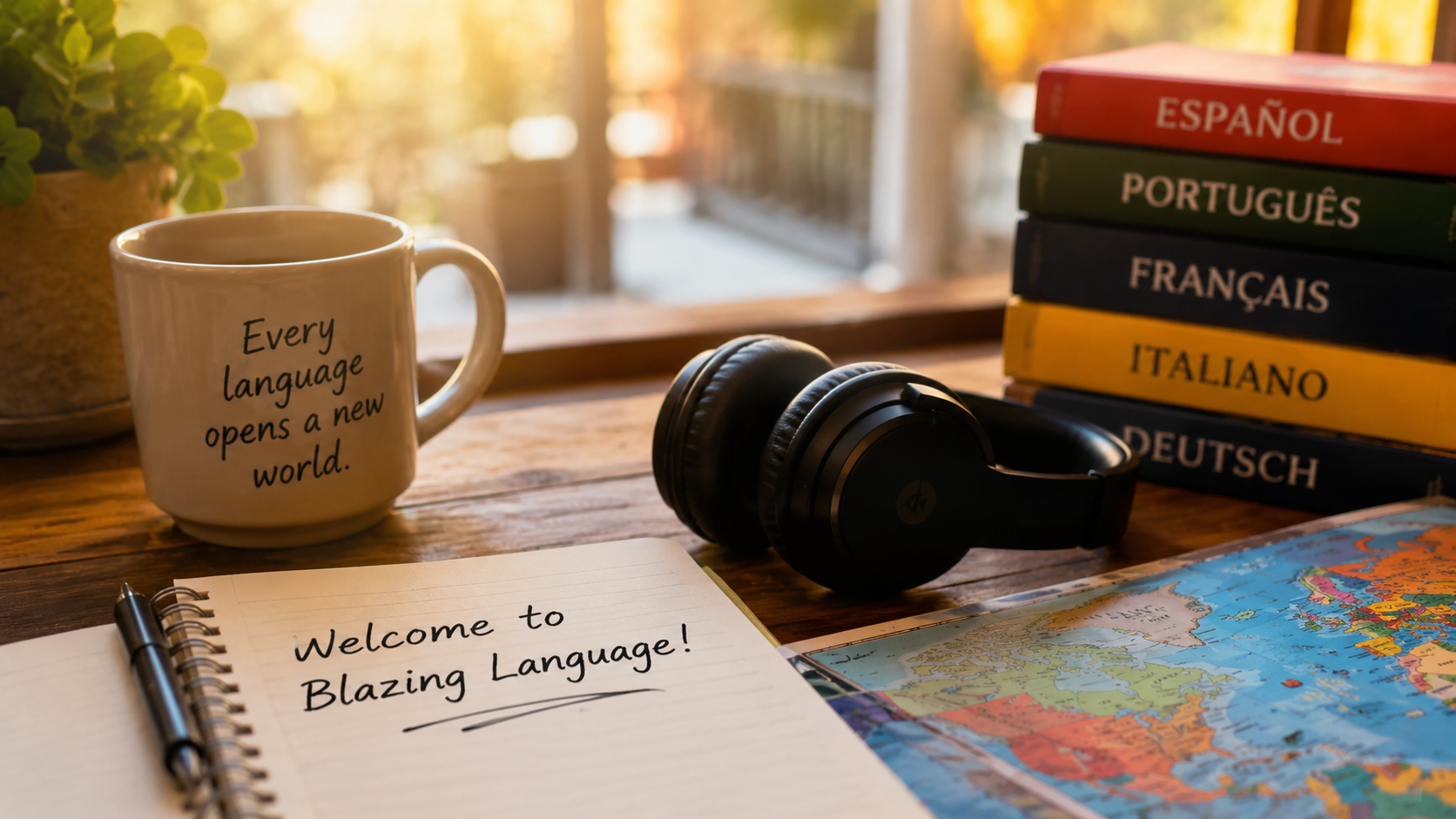
Hello, and welcome to Blazing Language. I’m Kenn Nesbitt, and I’m delighted you’re here.
Whether you’ve just started learning a new language or you’ve been studying for years, I hope these podcasts become an enjoyable part of your daily routine.
Before we begin exploring the language and culture together, I’d like to take just a few minutes to explain what Blazing Language is, how it’s different from other language-learning resources, and how to get the most from it.
First, Blazing Language isn’t designed to replace your favorite way of studying. In fact, I encourage you to keep doing whatever you’re already doing. Whether you’re taking a class, working with a tutor, using an app like Duolingo or Babbel, studying from a textbook, reviewing flash cards, or practicing conversations with friends, those are all valuable parts of learning a language.
Think of Blazing Language as the missing piece that brings everything together.
One of the biggest challenges language learners face is finding interesting material to listen to every day. Most courses teach vocabulary and grammar, but they don’t provide enough engaging listening practice. And even when they do, they often focus on ordering food, checking into hotels, or asking for directions.
Those are useful skills, of course. But languages are much more than that.
Every language is connected to a rich history, unique traditions, incredible food, fascinating people, beautiful places, and countless stories worth discovering.
That’s what Blazing Language is all about.
Each episode explores a different aspect of the culture, history, or everyday life of the people who speak the language you’re learning. Along the way, you’ll naturally encounter vocabulary, grammar, and expressions in context, while learning something genuinely interesting.
For subscribers, every episode also includes a transcript, an English translation, vocabulary lists, and worksheets that can help reinforce what you’ve heard. But even if you’re listening to the free podcast, you’ll still gain valuable exposure simply by listening regularly.
So how should you use these episodes?
My biggest piece of advice is this: don’t worry about understanding every single word.
In fact, if you understand most of what you hear but occasionally miss something, you’re probably right where you should be.
Your brain is remarkably good at recognizing patterns. The more you listen, the more familiar the sounds, words, and sentence structures become. Over time, things that once seemed difficult begin to feel natural.
You might even consider listening to an episode more than once. Listen the first time simply to enjoy the story. Then, if you’d like, listen again later, perhaps after reviewing the transcript or vocabulary. You’ll probably notice details you missed the first time.
Most importantly, try to make listening a habit.
Ten or fifteen minutes every day is far more valuable than several hours once a week. Language learning isn’t a sprint. It’s something that grows little by little through consistent exposure.
One of the things I love most about learning languages is that every new language opens the door to another way of seeing the world. You don’t just learn new words—you discover new customs, new ideas, new perspectives, and new ways of thinking.
That’s exactly what I hope you’ll find here.
Whether your goal is to travel, connect with family, make new friends, advance your career, or simply enjoy the challenge of learning something new, I hope these episodes make the journey both easier and more enjoyable.
Thank you for joining me.
In the next episode, I’ll tell you a little about my own journey—from software developer to children’s author to language learner—and how all of those experiences eventually led me to create Blazing Language.
After that, we’ll begin exploring the language, the culture, and the stories that make each one unique.
Welcome aboard, and happy learning!