(And Why It Matters for Language Learning)
If you’ve spent any time exploring language-learning websites, YouTube channels, or online communities, you’ve probably come across the term comprehensible input. It has become one of the most widely discussed ideas in language learning—and for good reason.
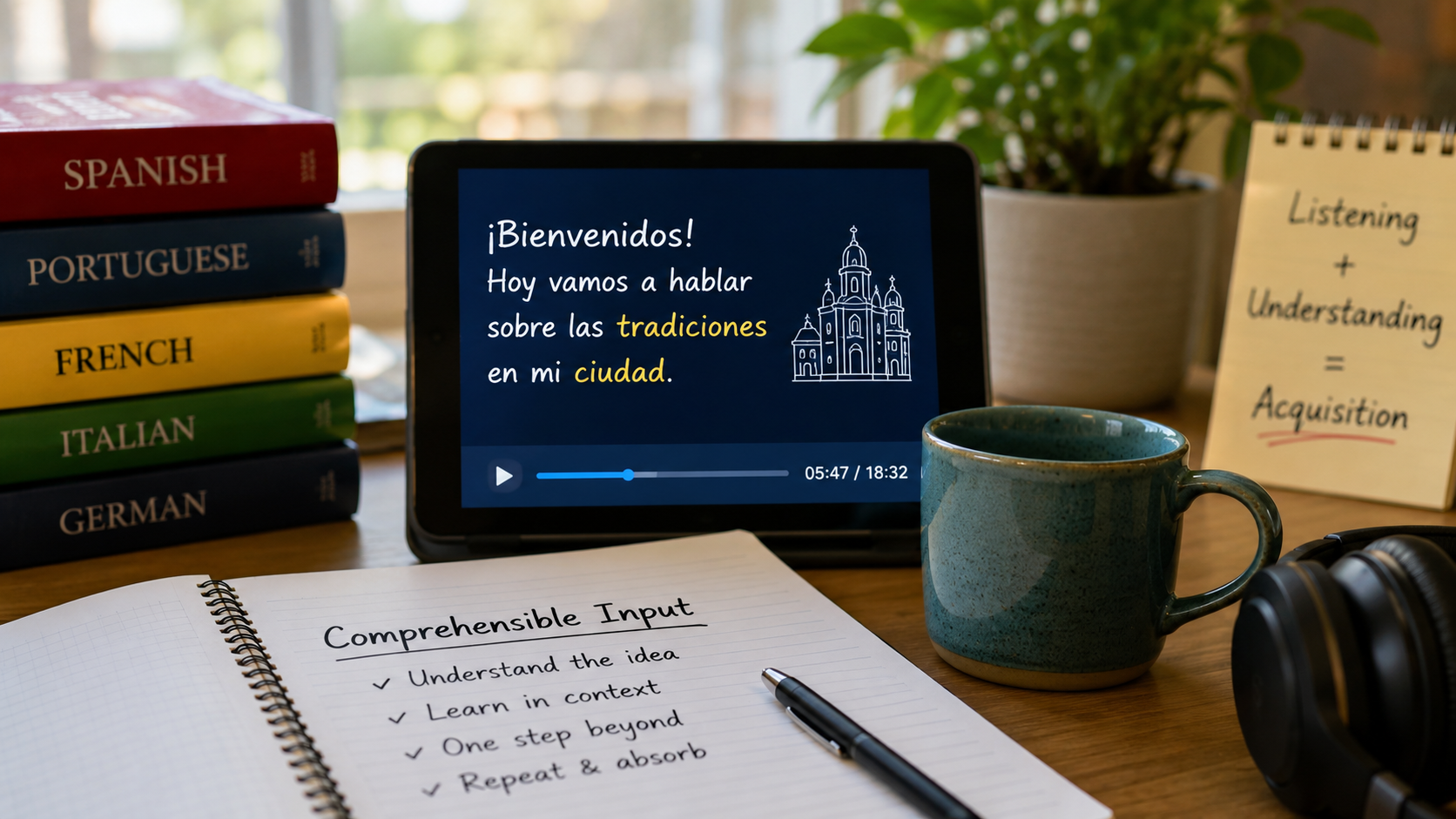
The basic idea is surprisingly simple: we learn languages most effectively when we are exposed to messages that we can mostly understand, even if we don’t understand every single word.
Think about how children learn their first language. Nobody hands a toddler a grammar textbook or a list of verb conjugations. Instead, children spend thousands of hours hearing language used in meaningful situations. They gradually figure out vocabulary, grammar, pronunciation, and patterns through repeated exposure.
Adults can learn in a similar way.
What Exactly Is Comprehensible Input?
Comprehensible input is language that is just slightly above your current level. You understand enough of the message to follow along, even though some words, phrases, or grammar structures may be new.
For example, imagine you’re learning Portuguese and hear:
“Hoje está chovendo, então vou ficar em casa e ler um livro.”
Even if you don’t know every word, you might recognize hoje (today), casa (house), and livro (book). Combined with context, you can probably figure out that the speaker is staying home and reading because it’s raining.
That’s comprehensible input in action.
The goal is not to understand 100% of what you hear. In fact, if you understand absolutely everything, the material may be too easy to help you grow. On the other hand, if you only understand 10 or 20 percent, your brain doesn’t have enough information to make sense of the message.
The sweet spot is somewhere in between: challenging enough to expose you to new language, but understandable enough that you can still follow the meaning.
Why Does It Work?
When we understand messages, our brains naturally begin noticing patterns. We start recognizing common words and expressions. We hear verb forms repeatedly in meaningful contexts. We encounter grammar structures over and over until they begin to feel familiar. Instead of memorizing hundreds of isolated rules, we gradually develop an intuitive sense of how the language works.
Think about your native language. Most of the grammar rules you use every day were never consciously memorized. You learned them through exposure.
Comprehensible input helps create that same kind of intuitive knowledge in a second language.
Does This Mean I Should Stop Studying Grammar?
Not at all.
One of the biggest misconceptions about comprehensible input is that it requires you to abandon all other forms of study.
Grammar explanations can be useful. Vocabulary study can be useful. Flashcards can be useful. Apps such as Duolingo and Babbel can be useful. Classroom instruction and private tutoring can be extremely valuable. The problem is that many learners spend most of their time studying language and very little time actually experiencing it.
Think of language learning like learning to play a musical instrument. Reading about music theory helps. Practicing scales helps. Working with a teacher helps. But eventually, you have to spend time listening to and playing actual music.
Comprehensible input is the language-learning equivalent of that real-world practice.
Where Blazing Language Fits In
At Blazing Language, our podcasts are designed to provide comprehensible input for learners. Each episode focuses on interesting topics such as culture, history, food, travel, music, daily life, and current traditions. Rather than drilling grammar rules, we present language in meaningful, engaging contexts.
The episodes are carefully designed to be understandable for learners at specific proficiency levels. We use high-frequency vocabulary, clear pronunciation, and natural language while avoiding the overwhelming speed and complexity that many learners encounter in native-level media.
This allows you to spend time listening to real language without constantly reaching for a dictionary.
You may not understand every word. That’s okay.
The goal is to understand the overall message and let your brain gradually absorb new vocabulary, grammar, and patterns through repeated exposure.
How to Use Blazing Language Alongside Other Resources
Many successful learners combine multiple approaches. You might use Duolingo or Babbel to build vocabulary and learn basic sentence structures. You might review flashcards to strengthen your memory of new words. You might take classes or work with a tutor to receive explanations and feedback. Then, you can use Blazing Language podcasts to reinforce and connect everything you’re learning.
For example, suppose your flashcards teach you the word for “market.” A grammar lesson teaches you a past-tense verb form. Later, you hear both appear naturally in a podcast episode about shopping at a local market. Suddenly those isolated pieces of information become part of a meaningful story.
This is where much of the real learning happens.
Be Patient
One of the hardest parts of language learning is accepting that progress often feels slow. You may listen to a podcast and feel like you missed a lot. That’s normal.
Language acquisition happens gradually. Every time you listen, your brain is collecting information. Words become familiar. Expressions become recognizable. Structures begin to make sense. Over time, things that once seemed difficult start to feel natural.
That’s the power of comprehensible input. And that’s why every episode of Blazing Language is designed not just to teach you about a language, but to help you experience it.
So put on your headphones, relax, and listen. You don’t need to understand everything. You just need to understand enough to keep going.