
For many adult learners, the dream of becoming proficient in a new language is often tethered to the idea of travel. We imagine that if we could only spend six months in a quiet village in Tuscany or a bustling neighborhood in Kyoto, the language would simply seep into our minds through the air. This belief leads to a common frustration: if we cannot afford to quit our jobs or leave our families for a long-term overseas stay, we feel that true progress is out of reach. We find ourselves asking a fundamental question: Can you create immersion at home?
The short answer is yes, but it requires a shift in how we define immersion. Traditionally, immersion was thought of as a geographic location. Today, language researchers and successful polyglots view immersion as an environment of the mind and the senses. It is not about where your feet are planted; it is about what your ears are hearing and what your brain is processing. By curating your daily surroundings and habits, you can replicate the most effective elements of living abroad without ever leaving your living room.
Understanding What Immersion Actually Means
In the context of language acquisition, immersion is the state of being surrounded by meaningful messages in your target language. Acquisition is a term used by linguists to describe the subconscious process of internalizing a language, similar to how children learn their first language. This is distinct from language learning, which usually involves the conscious study of grammar rules and vocabulary lists. While learning can be helpful for fine-tuning, acquisition is what allows you to actually speak and understand naturally.
When you are in a foreign country, you are forced into an immersive state because the environment provides a constant stream of messages you need to understand to navigate your day. However, simply being in a country isn’t what teaches you the language. It is the comprehensible input you receive while you are there. Comprehensible input is a concept developed by linguist Stephen Krashen, which suggests that we acquire language when we understand messages, even if we don’t understand every single word or grammatical structure within those messages.
If you can find ways to bring that same flow of understandable messages into your home, you are effectively creating an immersive environment. You are giving your brain the raw data it needs to start recognizing patterns, vocabulary, and the musicality of the language.
The Essential Role of Listening Practice
If you look at how humans naturally develop communication skills, listening always comes first. A child listens for thousands of hours before they ever utter a complex sentence. For adult learners, listening remains the most critical component of creating an immersive environment at home. It serves as the bridge between being a student of a language and being a participant in a culture.
Listening does more than just teach you words. It helps you grasp the prosody of a language—the rhythm, stress, and intonation that make a speaker sound natural. When you listen to native speakers, you are absorbing the cultural nuances of how people express emotion, how they hesitate, and how they emphasize certain points. This is why passive listening, such as having the radio on in the background, is less effective than active, focused listening where you are truly trying to follow the story or the message.
In a home immersion setup, audio should be your primary tool. This might involve listening to music, watching films, or following stories. The goal is to make the language a constant companion. Over time, the sounds that once felt like a wall of noise begin to separate into distinct words and phrases. This shift is a sign that your brain is successfully acquiring the language.
Building a Cultural Atmosphere
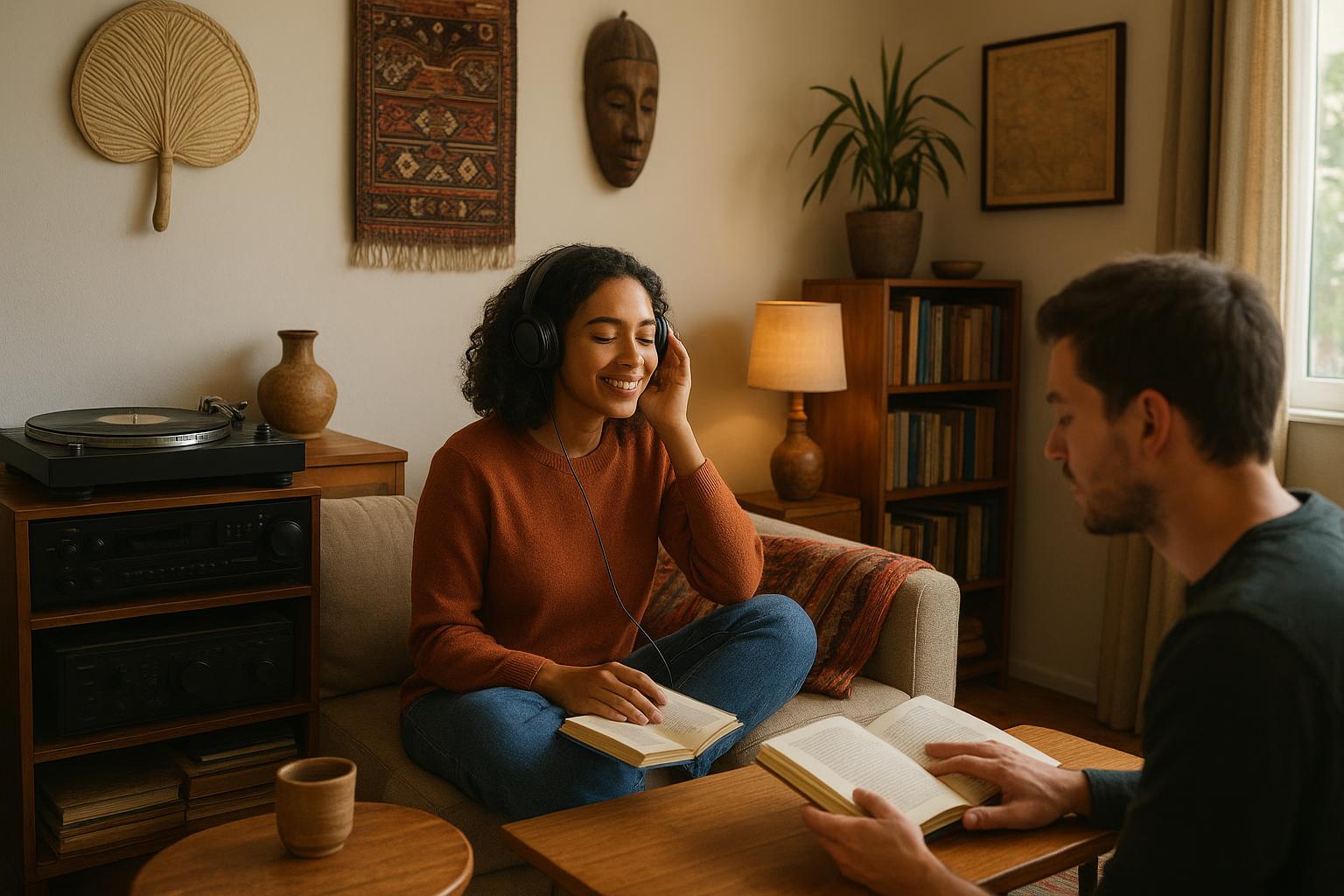
One of the reasons travel is so effective is the emotional connection we form with the culture. To recreate this at home, you should aim to make your environment feel culturally lived-in. In the featured image for this article, you see a home filled with cultural objects, music, and audio equipment. This isn’t just for decoration; it serves as a series of visual and auditory cues that keep your brain engaged with your target language.
Consider the objects in your home. You might place books by authors from the target culture on your coffee table or display art that reflects the regions where the language is spoken. When your physical space reflects the culture you are studying, the language stops feeling like a chore or a school subject and starts feeling like a lifestyle. It becomes part of your identity.
This cultural immersion also involves changing your digital environment. Many learners find success by changing the language settings on their phones or computers. While this can be challenging at first, it forces you to interact with the language in a functional way. However, the most profound cultural connection comes from the stories we consume. Whether it is a historical podcast or a modern drama, these narratives provide the context that makes the language meaningful.
Curating Your Input for Meaning and Interest
For home immersion to work, the content you choose must be interesting to you. If you find the material boring, your brain will naturally tune it out, regardless of how “educational” it is. One of the benefits of being an adult learner is that you have the autonomy to choose materials that align with your personal interests, whether that is cooking, history, technology, or philosophy.
The key is to find the “sweet spot” of difficulty. If the input is too easy, you won’t grow. If it is too difficult, you will become frustrated and give up. Ideally, you want to consume content where you understand the general gist of what is happening, even if there are gaps in your vocabulary. This allows you to use context clues to fill in the blanks, which is a core part of the acquisition process.
This is where specialized resources become invaluable. For instance, Blazing Language podcasts are designed specifically to provide this kind of balanced experience. They offer high-quality audio that focuses on cultural topics, allowing you to hear the language used naturally while ensuring the content remains accessible and engaging for those who aren’t yet ready for high-speed native broadcasts.
Developing Sustainable Daily Habits
The biggest challenge of creating immersion at home is not a lack of resources, but a lack of consistency. When you are in a foreign country, you have no choice but to use the language. At home, you have to make the choice every day. The best way to ensure success is to build sustainable habits that don’t feel like a burden.
Rather than trying to “study” for three hours on a Saturday, aim for thirty minutes of immersion every single day. This could be listening to a podcast during your morning commute, watching a short video while you eat lunch, or reading a few pages of a book before bed. These small pockets of time add up significantly over months and years.
A low-pressure approach is essential for long-term retention. If you treat language learning as a high-stakes task, you may experience anxiety, which actually hinders the brain’s ability to acquire new information. This is known as the affective filter. By keeping your home immersion relaxed and enjoyable, you lower that filter and allow your brain to process the language more effectively. Focus on the enjoyment of the culture rather than the speed of your progress.
The Power of Modern Technology
We live in a unique era for language learners. Never before has it been so easy to access authentic cultural materials from the other side of the world. High-definition video, high-fidelity audio, and instant access to global media mean that the “distance” between you and your target language is thinner than ever.
You can use smart speakers to play international radio stations, use streaming services to find films with original audio, and use apps to connect with native speakers for casual conversation. The technology acts as a portal. When you put on your headphones and start an audio story, you are effectively transporting your mind to another place. This “audio-visual immersion” is a powerful substitute for physical travel.
However, it is important to use technology mindfully. Avoid the temptation to use tools that do the work for you, such as instant translation apps that bypass the need for understanding. Instead, use technology to bring the raw, authentic language into your space so that your brain has to do the healthy work of deciphering and adapting.
Building Your Own Immersion Sanctuary
Creating an immersive environment at home is a creative project. It is about building a sanctuary where the language feels at home. This might mean setting up a specific “listening chair” in your house where you only consume content in your target language. It might mean curating a playlist of songs that you actually enjoy, rather than just songs that are popular.
As you build this environment, remember that culture is the heart of language. You aren’t just learning words; you are learning how a specific group of people views the world. When you approach your home immersion through the lens of cultural discovery, the process becomes intrinsically rewarding. You aren’t just waiting for the day you become “fluent”; you are enjoying the richness of the language every day.
The Long-Term Joy of Cultural Discovery
The journey of acquiring a language is a marathon, not a sprint. By creating an immersive environment at home, you are making that journey part of your daily life rather than a destination you are trying to reach. You will find that as your listening skills improve and your cultural understanding deepens, the language begins to feel less like a foreign object and more like a part of yourself.
You don’t need a plane ticket to experience the beauty of a new language. With a commitment to listening, a curiosity about culture, and the right resources to guide you, your home can become the perfect place to grow. Focus on the steady, calm habits that bring you closer to the language each day, and let the process of discovery be its own reward.